
Call for Free Estimate

Retaining walls · eastern Connecticut

In eastern CT, a retaining wall is three different jobs — priced by height.

Under 3 ft is landscaping. 3–5 ft is where drainage and base prep start deciding whether the wall stands for five years or fifty. Over 5 ft becomes an engineered job with stamped plans. We build all three.

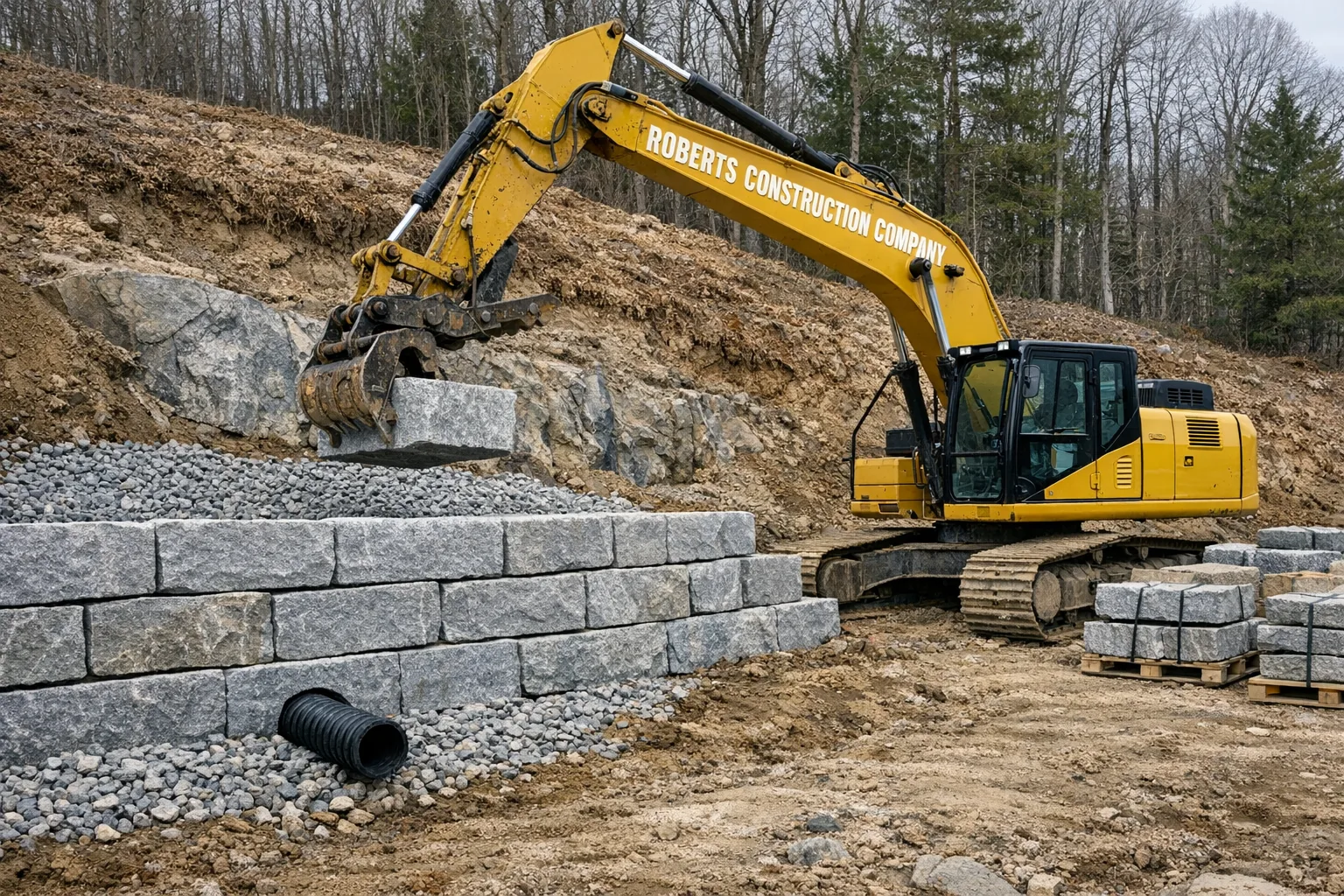
Roberts Construction Company excavator setting cut granite blocks on a dry-laid retaining wall with drain pipe visible at the base, rural eastern Connecticut
Granite block wall in progress · drainage set before the facing goes up

Three height zones. Three different jobs.

Height sets almost everything — materials, drainage detail, permit status, whether you need a stamped engineer. Here's how each band actually runs in eastern CT.

Under 3 ft

Decorative / landscaping

Gravity walls that don't need a permit.

At these heights, gravity does the work — stone, block, or concrete holding back a small grade change around a patio, planter, or driveway edge. No engineered design, no permit in most towns, straightforward build.

Typical build
  • ·Dry-laid fieldstone — eastern CT granite works beautifully
  • ·Segmental block (Allan Block, Versa-Lok) for a cleaner line
  • ·Boulder walls on larger residential lots
Drainage
Base gravel + daylighted outlet; simple but still required.
Permit
Typically no permit; confirm with your town.

3 – 5 ft

Functional / structural

Where drainage and base prep become everything.

This is the workhorse band — holding back a usable yard grade, a sloped driveway, or a walkout basement cut. Still often under the CT engineering threshold, but the margin is thin. A 4-ft wall with a surcharge behind it (a parked car, a shed, stored fill) almost always needs engineering.

Typical build
  • ·Segmental concrete block is the dominant system here
  • ·Poured concrete gravity walls on commercial sites
  • ·Geogrid reinforcement tied into the backfill at heights approaching 4 ft
Drainage
Perforated drain pipe at base, 3/4" clear stone backfill, filter fabric, daylight outlet. Non-negotiable.
Permit
Permit status depends on the town and surcharge conditions.

Over 5 ft

Engineered / tiered

Stamped plans, geogrid, and often a tiered build.

Tall walls are a different job. CT building code will require a stamped engineering design; the wall is often split into two or three shorter tiers with setbacks rather than built as a single face. Geogrid layers are tied into the backfill at fixed vertical intervals. Base course and footing get real attention — soft spots found here come back as wall failures later.

Typical build
  • ·Segmental block with engineered geogrid reinforcement
  • ·Poured or block-form concrete gravity walls
  • ·Stepped / tiered terraces on long sloped lots
Drainage
Engineered drainage system per stamped plans — typically multi-layer with a chimney drain.
Permit
Building permit + stamped engineer's plans required.

Walls we come in to fix

Four reasons eastern CT retaining walls fail.

  1. 01

    No drainage behind the wall

    Saturated backfill pushes the wall out. Most common failure we repair.

  2. 02

    Wrong base course

    Set on organic topsoil or unstable fill — wall settles unevenly.

  3. 03

    Freeze-thaw heave

    No drainage + CT winters = ice expansion lifting courses out of plane.

  4. 04

    Unaccounted surcharge

    Driveway, vehicle, or stockpile above a wall that was built for bare soil.

How a Roberts wall gets built.

Five steps. The first two decide whether the wall lasts.

  1. 01

    Walk the site

    Slope, soil, ledge check, surcharge above, drainage outlet options.

  2. 02

    Base prep

    Excavate, compact, set level base course — this is where walls live or die.

  3. 03

    Drainage

    Perf pipe, filter fabric, 3/4" stone. Daylight the outlet to grade.

  4. 04

    Build

    Stack, pour, or dry-lay. Geogrid at spec intervals on anything tall.

  5. 05

    Backfill + cap

    Graded compacted fill, final cap stones set with a weather-resistant adhesive.

Questions we actually get

Three things to know before you quote a wall.

At what height does a retaining wall need engineering in Connecticut?
Most eastern Connecticut towns follow the state building code's threshold: a retaining wall over 4 feet in height — measured from the bottom of the footing to the top of the wall — generally requires a design stamped by a licensed professional engineer. Walls supporting a slope, a surcharge (like a driveway or a building), or tiered walls where one is above another can trip the threshold earlier. We walk the site, measure, and tell you whether engineering is required before we quote.
Why does every wall need drainage behind it?
In eastern CT soils, water behind a wall is the #1 reason walls fail. Saturated backfill creates hydrostatic pressure that pushes the wall forward, and our freeze-thaw winters accelerate it — ice expands, then melts, then expands again. A proper wall gets a perforated drain pipe at the base, 3/4" clear crushed stone backfill, filter fabric to keep fines out, and a daylighted outlet. Walls built without that fail predictably within a few winters.
Can you build on ledge?
Yes. Sterling is granite country — we hit ledge on a lot of foundations and walls here, and we plan for it. Rock work is part of a normal wall build for us rather than a surprise line item. If we can't excavate deep enough for a standard footing, we pin or step the wall to the ledge instead.

General guidance. Always confirm current permit thresholds and engineering requirements with the building official in the town where the wall is being built.

Planning a wall? Send us the lot — we'll walk it.

Ready to Start Your Project?

Contact us today for a free consultation and estimate. Our team is ready to help with your construction needs.