(401) 479-1472
Roberts Construction Company equine facility construction in eastern Connecticut

Equine facilities · Eastern CT · RI · MA

Barns, arenas, run-ins, paddocks — built by the same crew that digs the foundation.

Two-stall starter barns to commercial equestrian centers. Indoor arenas on engineered post-frame. Run-ins, paddock infrastructure, and in-house welded stall fronts. We've been building horse facilities in eastern CT for two decades.

What makes equine work different

Same crew, same trucks. Different code.

Equine facility work draws on the same machines, the same crews, and the same discipline as residential building — but the requirements are different. Stall fronts have to hold a 1,200-pound animal. Ventilation has to clear ammonia without drafts. Arena footing has to drain. Wash-stall plumbing has to survive freeze-thaw where there's no winter heat.

Two decades of barn work in eastern CT means we know which post-frame supplier ships on time, which ridge-vent design holds up to our nor'easters, what NDDH wants on the wash-stall septic, and which arena footing actually drains in Connecticut clay-rich till.

And we do the welding ourselves — stall fronts, dutch doors, hay racks. That matters because the fab gets done to the barn we're building, not to a catalog measurement that almost fits.

What we build for equine

Six lines of equine facility work, all under one contract.

Horse Barns & Stables

From 2-stall starter barns to 20+ stall commercial facilities. Conventional stick-frame or engineered post-frame depending on size and use.

  • 2-stall to 20+ stall layouts
  • Aisle widths sized to the operation (10 to 14 ft)
  • Tack rooms, feed rooms, wash stalls, restrooms
  • Ventilation designed per stall count, not per cubic foot

Indoor Riding Arenas

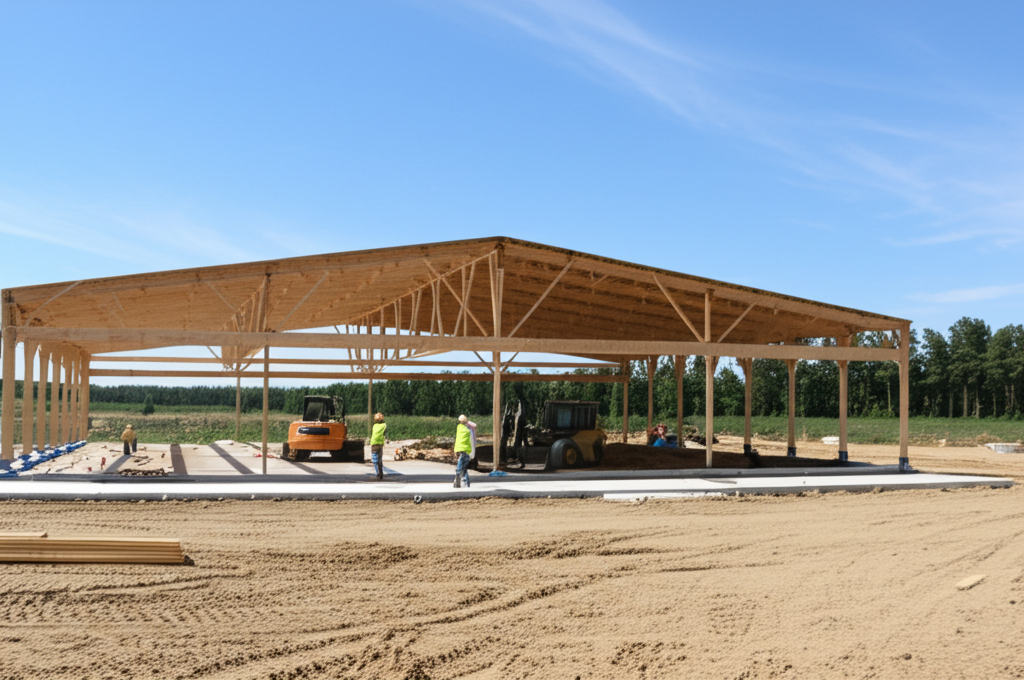
Engineered post-frame buildings with clear-span trusses. Standard 80 ft wide, 100+ ft on request, sized to the discipline.

  • Engineered trusses to 100+ ft clear span
  • Code-compliant snow load (30 psf base in CT)
  • Sand + textile or sand + waxed-fiber footing options
  • Subsurface drainage and graded base

Outdoor Arenas & Rings

Properly-prepared outdoor rings with compacted stone base, perforated drainage, and discipline-appropriate footing — built to drain, not to puddle.

  • Site grading and subgrade compaction
  • Perforated drainage to daylight
  • Footing selection per discipline
  • Dust control and maintenance plan

Run-in Sheds & Loafing Sheds

Three-sided shelter for pasture turnout. Sized to herd count, sited to the prevailing winter wind, on a compacted pad with proper drainage.

  • Sized to herd count (10 sq ft per horse minimum)
  • Sited for winter wind protection
  • Compacted gravel pad with crowned drainage
  • Optional skylight, hay storage, or fly-control attachments

Paddock & Pasture Infrastructure

Below-grade paddock site prep, frost-line water lines, gate posts, mud-control pads, and the access roads connecting it all.

  • Paddock site prep and grading
  • Frost-line water lines to remote paddocks
  • Mud-control pads at gates and high-traffic areas
  • Gravel access drives sized for hay-truck access

Stall Fronts & Barn Hardware

In-house welded stall fronts, dutch doors, grilles, hay racks. Built to the actual barn dimensions, powder-coat-ready or galvanized.

  • Stall fronts, dutch doors, grilles
  • Sliding-door hardware and rail systems
  • Hay racks, water-bucket holders, blanket bars
  • Powder-coat-ready or hot-dip galvanized

Barn ventilation

Air change without drafts on the horses.

We design ventilation per stall count and barn footprint. Eastern Connecticut barns benefit from generous passive flow — ridge vent, soffit, dutch doors on the stall side. The goal is clearing ammonia and condensation without putting the horses in a draft path.

For tightly closed-up winter days, we add eave vents and sometimes mechanical exhaust on larger facilities. The biggest mistake we see in field-built barns is undersized ventilation that fights itself once stocking density goes up — we size it for the operating peak, not the design average.

Arena footing

The drainage matters more than the footing.

Sand + textile is the default for dressage and general work. Sand + waxed-fiber adds cushion for jumping and reining. Western disciplines often run a deeper sand-only profile. What matters more than the surface choice is what's underneath — compacted stone base graded for runoff, with a perforated drainage system below.

CT clay-rich till sites need especially careful drainage design. We've seen more arenas fail from inadequate drainage than from wrong footing — the surface is the part you notice, the drainage is the part that has to actually work.

Frequently asked

Timelines, permits, and what we're comfortable taking on.

How long does a horse barn build take?
A 4-stall barn with tack room and aisle takes us 8–14 weeks from foundation cut to walk-through. A larger 10–12 stall facility with indoor arena, wash stall, and viewing area runs 6–10 months. The longest single variable is the arena — engineered post-frame with a clear span of 80+ ft takes serious lead time on materials.
What's the right barn ventilation for eastern Connecticut?
Ridge vent + soffit + dutch doors on the stall side, sized to the barn footprint and stocking density. New England barns benefit from generous passive ventilation — the goal is air change without drafts on the horses. We design ventilation per stall count, not per cubic foot. For closed-up winter days we add eave vents and sometimes mechanical exhaust on larger facilities.
Can you do indoor arenas?
Yes. Most of our indoor arena work uses engineered post-frame construction with clear-span trusses — 80 ft wide is standard, 100+ ft on request. Roof pitch matters for snow load (CT code is 30 psf on most parcels). We coordinate the design with the truss supplier and handle foundation, slab or compacted-base footing, drainage, and finish.
What arena footing do you install?
Depends on the discipline. Dressage and general work runs sand + textile or sand + waxed-fiber on a compacted stone base. Jumping and reining benefit from added textile for cushion. Footings get installed over a graded, compacted base with a perforated drainage system underneath — the drainage matters more than the footing material on a CT lot with seasonal rain.
Who permits an equine facility?
Town building department for the structure, town zoning for the use (especially commercial boarding/lesson operations), and NDDH or RIDEM for any septic associated with a bathroom or wash stall. Agricultural-zoned land in CT has fewer restrictions; residentially-zoned lots may need a variance for commercial equine use. We pull all the permits as part of the build.
Do you do paddock infrastructure — fencing, run-ins, water?
Yes. We're excavation-first, so paddock site prep, fence-line clearing, frost-line water lines to remote paddocks, and run-in shed pads are all in-house. Fence installation we coordinate with a specialty contractor; everything below grade and the run-in itself we handle.
Can you do stall fronts and barn-hardware fabrication?
Yes — we have an in-house welding line that fabricates stall fronts, dutch doors, sliding-door hardware, hay racks, and water-bucket holders to the exact dimensions of the barn we're building. Powder-coat-ready or hot-dip galvanized finishes. See our /services/welding page for the welding side of the work.

Ready to Start Your Project?

Contact us today for a free consultation and estimate. Our team is ready to help with your construction needs.